Luffing Crane vs Hammerhead Crane: Which One Fits Your Site?
- By Admin
- 20 August 2026
Choosing between a luffing crane and a hammerhead crane is not simply a question of which crane has higher capacity.
The better choice depends on what the crane needs to do on your site.
A hammerhead crane can be highly effective when the site provides enough swing clearance and the project requires broad horizontal coverage. A luffing crane becomes more useful when the working environment is restricted by neighbouring buildings, property boundaries, roads, other cranes or oversailing limitations.
That distinction matters because a crane that looks suitable on its specification sheet may become inefficient once actual site constraints are considered.
Luffing Crane vs Hammerhead: What Actually Changes?
The biggest difference is how the jib operates.
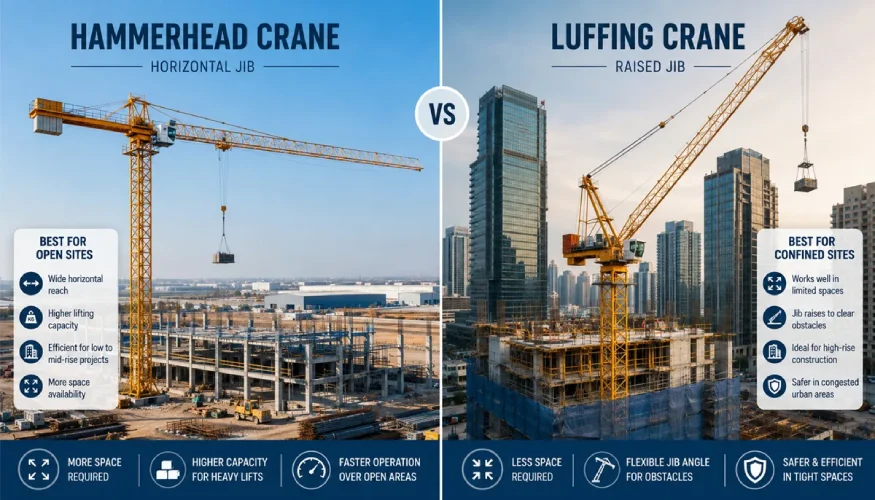
A hammerhead tower crane uses a horizontal jib. The trolley travels along the jib to position the load at different radii.
A luffing tower crane changes the angle of its jib to alter the working radius.
That difference becomes important when horizontal swing space is limited.
For example, an open industrial project may have enough room for a hammerhead crane to cover a large working area. On a tightly surrounded urban site, the same jib length could create clearance or oversailing problems.
So the real question is:
How much horizontal space does your crane have to work with?
When Does a Hammerhead Crane Make More Sense?
Hammerhead cranes are generally more practical when the site has sufficient clearance and the project requires regular movement across a broad working radius.
They can be a strong option for:
- Open industrial sites
- Large residential developments
- Warehouses and logistics parks
- Large construction plots
- Projects with fewer oversailing restrictions
- Repetitive lifting across a wide working area
Their horizontal jib arrangement makes it straightforward to move loads between different points around the crane.
Open site + broad coverage requirement = hammerhead may be the simpler choice.
When Is a Luffing Crane the Better Choice?
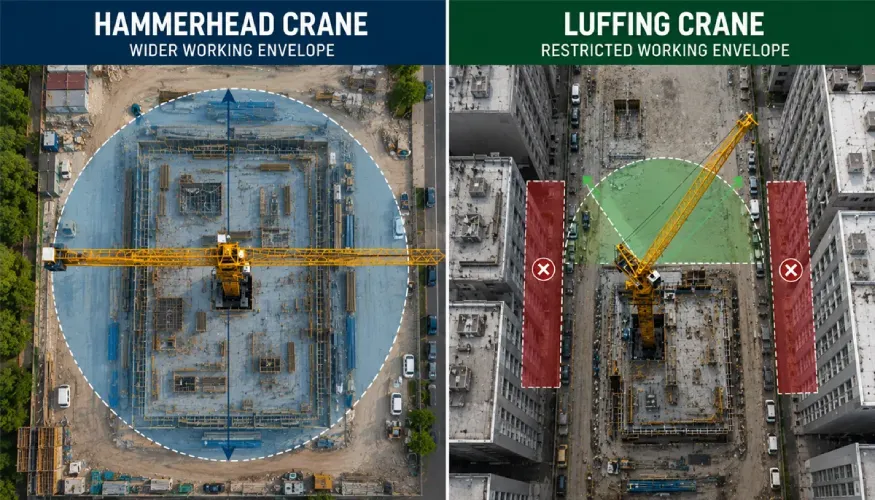
The decision changes when the crane operates inside a restricted lifting envelope.
A luffing crane can be considered when the project has:
The ability to change jib angle allows the crane to work within a more controlled radius.
This is particularly relevant to high-density construction where the problem is not simply how far the crane can reach, but where the jib is allowed to operate.
For projects with these constraints, see Cangraft's luffing tower crane solutions for the type of applications where a luffing configuration becomes relevant.
5 Site Conditions That Should Decide Your Crane
The luffing-versus-hammerhead decision should start with the site, not the crane brochure.
1. Oversailing Restrictions
If the jib cannot safely or legally swing over neighbouring properties, public roads or operational buildings, a luffing configuration may offer greater control over the working envelope.
2. Required Working Radius
Check where the majority of lifts will actually take place.
A crane that has adequate maximum capacity may still be unsuitable if required loads are being handled at long radius. Compare the load chart at the actual working radius, not just the headline capacity.
3. Surrounding Structures
Existing buildings, adjacent towers and other structures can restrict jib movement.
The tighter the surrounding environment, the more important controlled boom positioning becomes.
4. Multiple Crane Operations
When two or more tower cranes operate on the same project, their working envelopes need to be coordinated.
Luffing configurations can help reduce unwanted overlap where site geometry makes conventional jib arrangements difficult.
5. Project Workflow
Crane requirements can change as construction progresses.
Consider:
- Initial structural work
- Upper-floor construction
- Façade and MEP installation
- Heavy equipment placement
- Final lifting requirements
The best configuration is the one that remains practical across the actual construction sequence, not just during the first phase.
Luffing vs Hammerhead: Quick Decision Guide
Project condition |
More suitable starting point |
|---|---|
| Large open construction site | Hammerhead |
| Wide horizontal coverage required | Hammerhead |
| Few surrounding structures | Hammerhead |
| Tight urban plot | Luffing |
| Limited oversailing | Luffing |
| Nearby buildings | Luffing |
| Multiple cranes with restricted clearance | Luffing may be preferable |
| Large repetitive lifts across an open site | Hammerhead |
| Restricted working envelope | Luffing |
This is a planning guide, not a substitute for a project-specific lift and crane study. Final selection still depends on load charts, foundation/base requirements, height, jib configuration, wind conditions, site geometry and applicable safety requirements.
A Practical Site Scenario
Consider a commercial project where the available plot is surrounded by existing buildings.
The initial idea is to install a conventional hammerhead crane because the project requires a relatively large working radius.
During planning, however, the team identifies three constraints:
At this point, simply increasing the hammerhead crane's capacity does not solve the problem.
The issue is operating space, not lifting capacity.
A luffing configuration may provide a more suitable solution because the project team can plan the jib angle and working envelope around the surrounding restrictions.
That is the kind of situation where the difference between the two configurations becomes commercially important.
Don't Choose the Crane Before Checking These Numbers
Before requesting a luffing or hammerhead crane quotation, prepare at least these project inputs:
These details make a crane requirement much more meaningful than simply asking for a “10-ton” or “12-ton” tower crane.

Which Configuration Fits Your Project?
There is no universally better option.
A hammerhead crane is generally more practical for open sites where broad horizontal coverage is available. A luffing crane becomes more suitable when oversailing, neighbouring structures, restricted plots or multi-crane coordination limit jib movement.
Before deciding, compare the actual load, working radius, hook height and site restrictions against the crane's configuration and load chart.
If those requirements point toward a luffing configuration, explore Cangraft's Luffing Tower Crane solutions for project-specific requirements.

