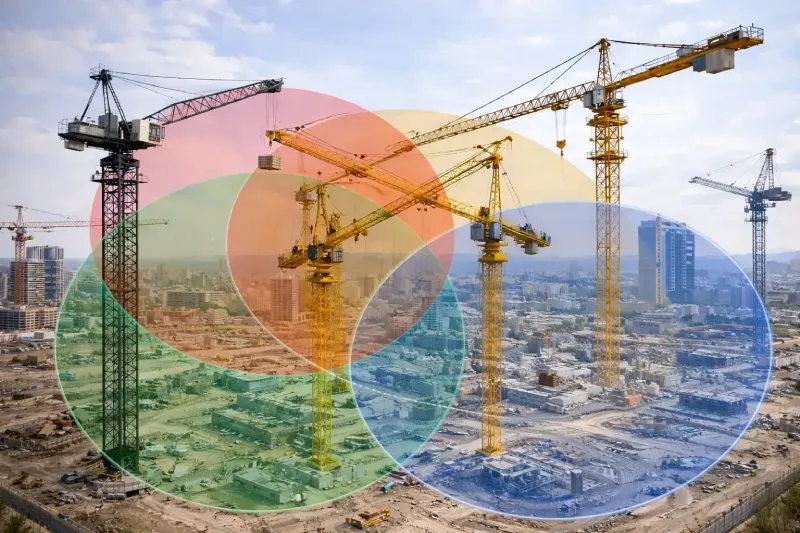
Multiple tower cranes operate at similar heights with overlapping slewing paths. Controlled zoning prevents unintentional envelope intrusion during peak lifting hours.
Collision Risks in Multi-Crane Sites & How to Control Them
- By Admin
- 9 January 2026
Large construction projects increasingly rely on multiple cranes operating within limited airspace. While this improves productivity, it also introduces collision risks in multi-crane construction sites that can disrupt operations, compromise safety, and lead to costly downtime.
These risks are not theoretical. They arise from real site conditions such as overlapping work zones, blind lifts, and constant changes in crane movement patterns. Understanding how these collision risks develop, and how they are controlled, is essential for contractors, project managers, and safety teams working on complex construction sites.
Why Collision Risks Increase on Multi-Crane Sites
Collision risks in multi-crane construction sites typically emerge due to spatial and operational overlap rather than equipment failure. As project density increases, so does the complexity of crane coordination.
Common contributing factors include:
On high-rise and infrastructure projects, these conditions often exist together, increasing the probability of unintended crane interference.
Types of Crane Collision Scenarios on Active Sites
Not all collision risks are the same. On multi-crane construction sites, risks generally fall into three practical categories.
1. Crane-to-Crane Interference
This occurs when the operating radius, jib, or counter-jib of one crane enters the working envelope of another. Without coordinated controls, even minor misjudgments can result in near-miss incidents.
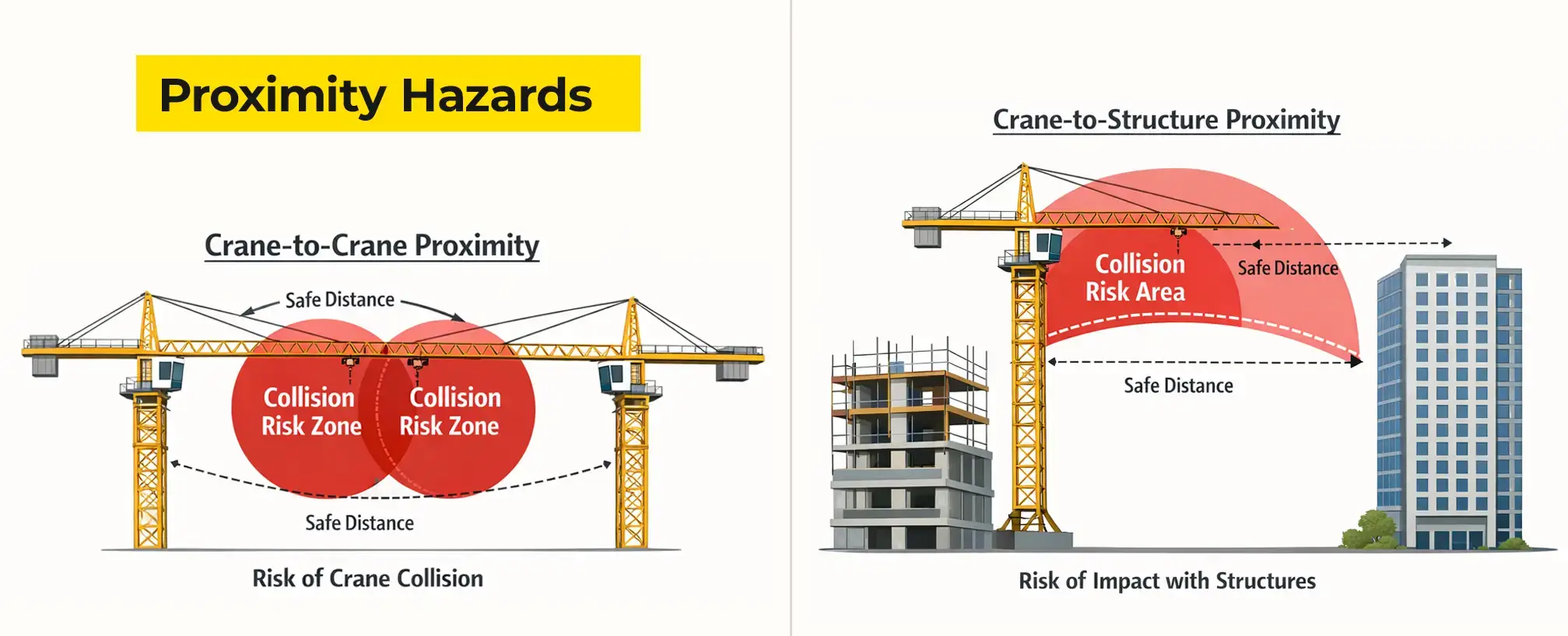
2. Crane-to-Structure Contact
As buildings rise, cranes operate closer to permanent structures. Blind spots increase, especially during slewing or load positioning near façades and slabs.
3. Load Path Conflicts
Loads suspended from different cranes may cross paths during lifting or positioning. Wind conditions and communication delays further amplify this risk.
Each of these scenarios represents a real operational hazard, not a compliance checklist item.
Operational Impact of Uncontrolled Collision Risks
When collision risks in multi-crane construction sites are not properly managed, the impact goes beyond safety incidents.
Uncontrolled risks can lead to:
For large projects, even a short shutdown caused by a collision risk event can have cascading effects on timelines and coordination.
How Collision Risks Are Controlled on Multi-Crane Sites
Modern construction sites rely on automated crane collision prevention systems to manage these risks consistently, rather than depending solely on manual coordination.
Control methods typically include:
 Defined zoning and exclusion areas that restrict crane movement into high-risk zones
- Real-time monitoring of crane positions and operating envelopes
- Predictive alerts that warn operators before unsafe proximity occurs
- Centralized coordination logic that accounts for multiple cranes simultaneously
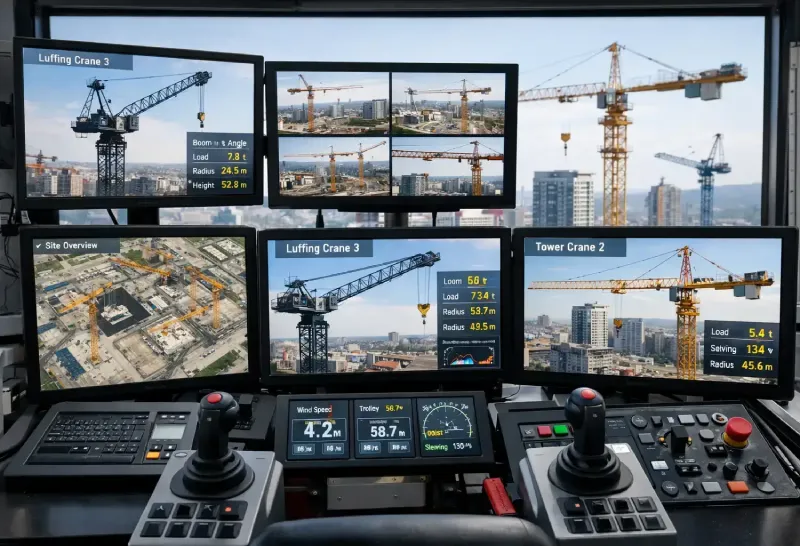
These controls are designed to reduce dependency on human judgment alone, especially in congested environments.
On complex sites, such systems are commonly integrated as part of broader crane safety and coordination planning. When implemented correctly, they support smoother operations without interfering with productivity.
(For projects where automated collision prevention systems are evaluated, controlled coordination technologies are often discussed in relation to advanced crane safety solutions.)
Practical Site Scenarios Where Controls Make a Difference
Infrastructure and Metro Projects
Cranes positioned along linear corridors face changing spatial constraints as construction progresses. Real-time monitoring adapts to these evolving conditions.
Industrial and Plant Construction
Restricted layouts and heavy components demand precise load path coordination, where predictive alerts significantly reduce risk exposure.
These scenarios highlight why collision risk control is a continuous operational process, not a one-time setup.
Why Managing Collision Risks Supports Project Efficiency
Effectively controlling collision risks in multi-crane construction sites does more than improve safety, it stabilizes operations.
Well-managed sites typically experience:
From a project management perspective, this translates into predictability, which is often more valuable than marginal speed gains. Learn how anti-collision systems work in tower cranes.
Final Perspective: Collision Risk Control Is a Planning Discipline
Collision risks on multi-crane construction sites are a natural outcome of dense, high-activity environments. They cannot be eliminated through procedures alone.
Instead, they are managed through:
 Early risk identification
- Site-specific coordination planning
- Continuous operational controls
Projects that treat collision risk control as a core planning discipline, rather than an afterthought, consistently maintain safer and more reliable crane operations.

