Areas where crane movement is completely blocked to prevent contact with:
- Adjacent cranes
- Permanent structures
- High-risk site areas
On modern construction sites, installing an anti-collision system is only the first step.
How the ACD is configured and how operating zones are defined determines whether the system actually prevents incidents or merely generates alerts.
ACD configuration and zoning in tower cranes is a site-specific engineering task, not a plug-and-play setting. On multi-crane and high-rise projects, incorrect zoning logic can create blind spots, false alarms, or operational constraints that reduce efficiency instead of improving safety.
This article explains how ACD configuration and zoning are approached in real construction environments, based on practical site scenarios rather than theoretical setups.
Tower cranes rarely operate in isolation. As sites grow vertically and horizontally, crane movements overlap in ways that cannot be managed through procedures alone.
 Which movements are allowedWhich zones are restrictedHow proximity risks are calculatedWhen alerts or interventions are triggeredExcessive warnings that operators begin to ignoreRestricted lifting zones that slow progressUncontrolled overlap between crane working envelopes
This is why ACD configuration and zoning in tower cranes must reflect actual site conditions, not generic layouts.

Virtual boundaries that control crane movement relative to other cranes and fixed structures.
These zones are typically classified into:
Areas where crane movement is completely blocked to prevent contact with:
Zones that allow movement but generate alerts when a crane approaches predefined limits. These zones support operator awareness without stopping operations.
In complex multi-crane sites, certain cranes or lifting paths may be given priority to avoid operational deadlocks.
Effective zoning balances risk prevention and operational flexibility, which is why configuration must evolve as the site progresses.
Learn - how anti-collision systems work in tower crane operations and how zoning logic supports safe coordination.
Before an anti-collision system is commissioned, zoning decisions are defined during crane layout and lift planning.
During this stage, engineers evaluate:
ACD configuration and zoning in tower cranes is aligned with real operating workflows rather than static site drawings. As construction progresses, zones are reviewed and adjusted to reflect changes in crane height, jib overlap, and site priorities.
This planning-led approach ensures zoning controls support safe and efficient crane operations without unnecessary restrictions.
As building height increases, crane jibs begin to overlap vertically. ACD zoning is configured to:
Without periodic reconfiguration, early-stage zoning becomes ineffective during later phases.

Urban projects often operate within tight boundaries with limited crane spacing. In such cases:
This approach reduces unnecessary interruptions while maintaining safety margins.
On metro or corridor-based projects, cranes operate along changing alignment paths. ACD configuration here must:
Static zoning models are rarely effective in these environments.
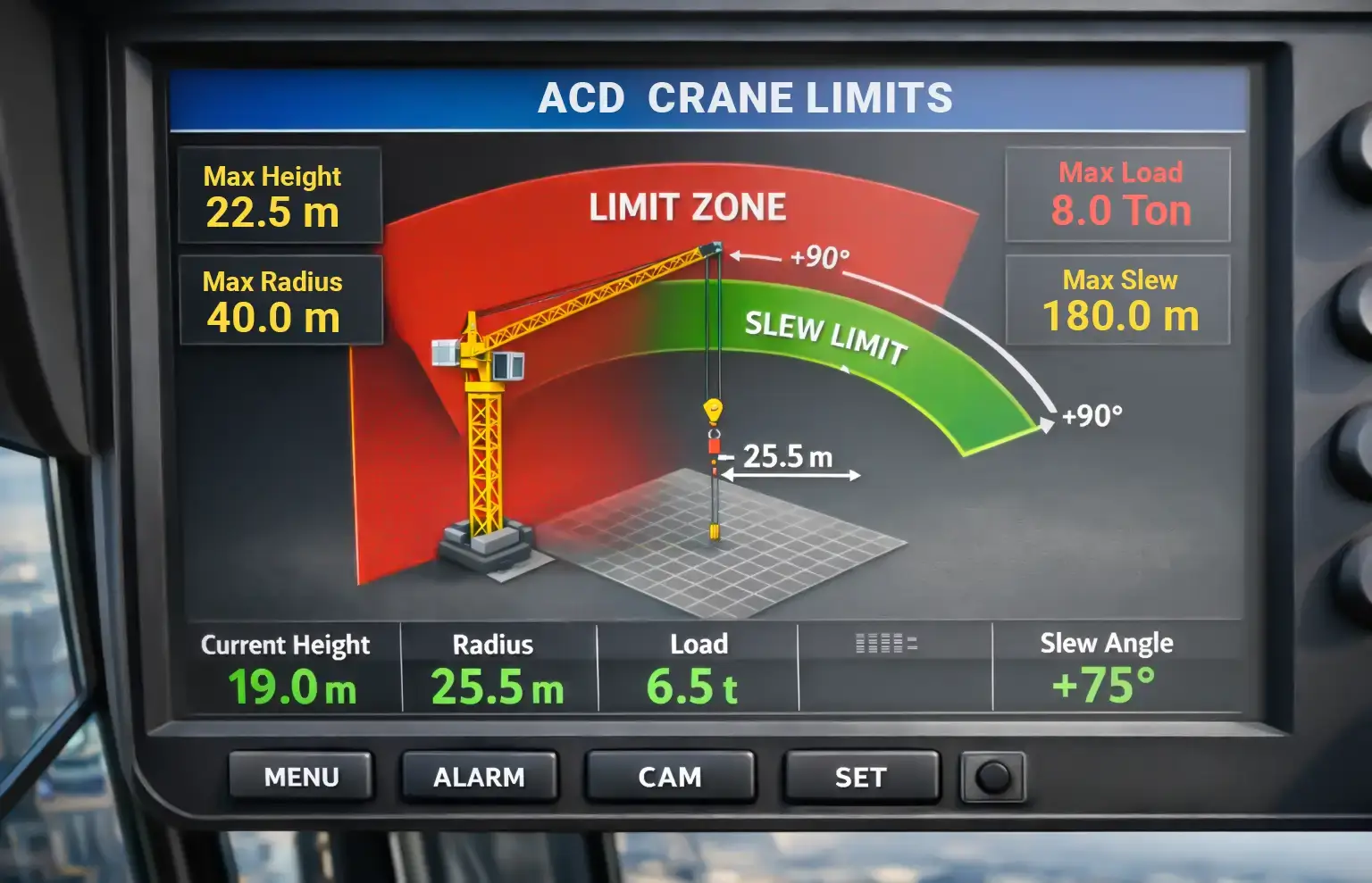
Even advanced systems can underperform if configuration is not handled correctly.
Common issues include:
These mistakes do not reflect system limitations but configuration oversights.
On sites with multiple tower cranes, configuration is as much about coordination as it is about collision prevention.
Well-configured ACD zoning:
 Clarifies movement hierarchy between cranesReduces reliance on verbal coordinationSupports smoother simultaneous lifting operationsImproves predictability for planning teams
This is why ACD configuration and zoning in tower cranes is often integrated into overall lift planning and site safety strategies, rather than treated as a standalone task.
The effectiveness of collision risk management depends heavily on how accurately zoning reflects real-world conditions.
When configuration aligns with:
 Actual crane geometrySite constraintsOperational workflows
The system functions as a preventive control, not a reactive alarm.
On complex sites, ACD configuration is commonly discussed alongside broader crane collision control systems that support coordinated operations across multiple cranes.
Construction sites are dynamic environments. ACD zoning that works during early stages may become obsolete within weeks.
Regular reviews are essential when:
Treating ACD configuration as a living system ensures that safety controls remain aligned with site realities.
ACD configuration and zoning in tower cranes is not about software settings, it is about translating site risk into control logic.
Projects that invest time in proper zoning:
As construction environments become more congested, configuration quality increasingly determines whether anti-collision systems deliver real value on site.

